Illuminate:
Radical, rooted, and rising reflections.
Advent
We are about to enter Advent, the first season in the new church year. January may be the new year in the Julian calendar, but new year comes at the end of November or early December in the Christian calendar. December feels to us like the end of the year- the month to wrap things up. The Christian year does something different this month- it begins.
The word Advent come from the Latin word for coming. The season is a time of preparation, of anticipation. Advent anticipates endings- oppression and war will end. Angels sing of Peac on Earth. The long wait for the Messiah. Joy to the World. The season anticipates the end of waiting for God to show up. And yet. Angels sang. God came incarnate. The baby was born. The world has changed but nothing seems that different. In fact, though this is the most beautiful time of year, the bible tells of horrific violence at the same time. A Baby was born surrounded by angels and shepherds. And then his family fled a murderous King calling for the death of all the infant boys. Herods and Pilates and Caesars continue to plot and dominate and oppress, even now.
So Advent is really the story of two Advents: the one that happened with the birth of Jesus- and another Advent still to come- the fulfillment of that promise. The season of Advent is about both. The waiting for the birth of Jesus and the waiting for peace. 2000 years ago, now, and the future. Christian theology tells of the tension between already and not yet. Christ came and taught and showed us how to live, and the Holy Spirit is with us. Powers of Empire still resist that message of Love. There is Creation and then constant recreation. God’s time is not our time.
Medieval theologian Bernard of Clairvaux spoke of a middle Advent, between the birth of Jesus 2000 years ago and the second coming, whenever that occurs. The coming in between is more subtle, more quiet. This coming of Christ takes place in our hearts, in our spirits, as we open ourselves to love. “If anyone loves me, they will keep my words, and God will love them, and we shall come to them” (John) If we love Christ, we will keep his words- loving God and neighbor- and God shall come to us. We celebrate the first coming. We have no idea about the second. The middle coming, though, that one we choose. Do we open our hearts to the Cosmic Christ? Do we choose hope, peace, joy, and love? Do we allow Christ to be manifest in us? "What good does it do me if Christ was born in Bethlehem once if he is not born again in my heart through faith?" Origen of Alexandria (ca 185-253). This is the true challenge of Christmas- allowing Christs love to be born in us, not just in December, but always.
In a recent clergy meeting, we discussed Advent. The prompt question was what the season means to each of us. I adore Advent, partly because it is a reminder that things are kind of supposed to be crappy now. This is the nature of already and not yet. Advent reminds us that we are between times people. In this world, there is Empire. We are to resist it. There are Herods. We are to resist them. They kill children. We are to care for children. They force families to flee violence. We are to love those families. They support systems in which a few have great wealth while most have little. We are to feed the hungry and set free the oppressed. Between times, there is cruelty and greed and violence, and there is still God’s promise. If we allow Christ to be born within us, the kin-dom of God can sneak in, even in the midst of Empire and Herod’s machinations.
We don’t know Jesus’ actual birthdate, of course. He didn’t have an official birth certificate. No one at the time did, and he was some lowly peasant born into a poor family in Roman dominated Judea. But this time of year when days are so long, Christmas comes, and with Christmas, light begins to return to the world. The coming of the light is slow but it happens. When times are the darkest, love is born and the days get just a little brighter- a day at a time and in increments of minutes, but the light is there. It is coming. So in this time of darkness, Can love and light be born within us? Dear ones, I hope so.
Blessed Advent. Merry Christmas. Pastor Jennifer
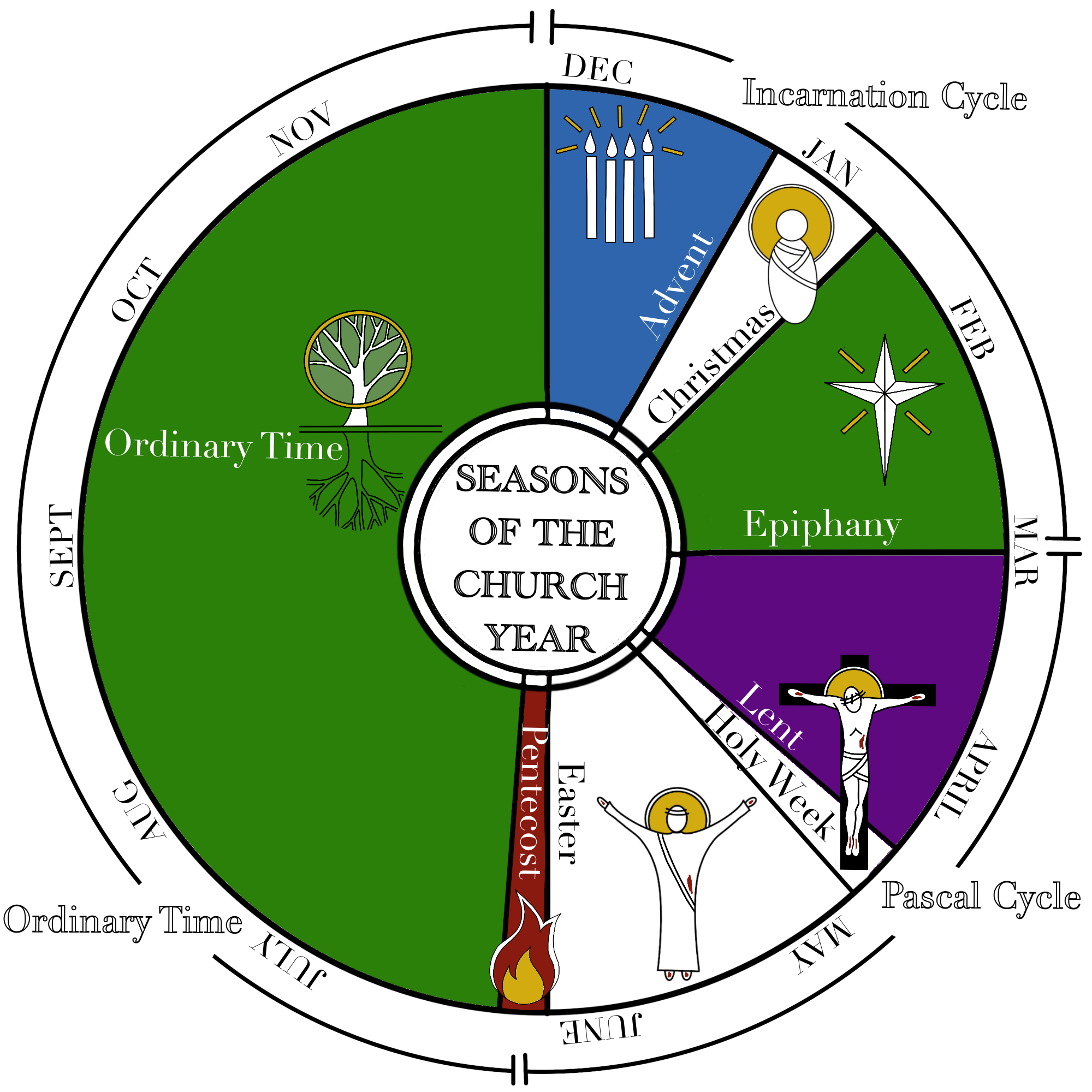
Liturgical Colors and their Seasons---
The use of colors to differentiate liturgical seasons became a common practice in the Western church around the fourth century. At first, use of colors varied considerably but by the 12th century Pope Innocent III systematized the use of color: Violet, White, Red and Green. The Lutheran and Anglican churches that emerged from the Reformation retained the traditional colors but they disappeared entirely, along with most other ritual, from Reformed churches. During the 20th century, the ecumenical Liturgical Movement prompted the rediscovery of ancient Christian ritual—including the traditional colors of the Western church, so most Reformed churches, including UCC, observe liturgical calendar and colors. The colors express emotions or ideas associated with each season of the liturgical year.
Blue: Advent. Originally, Advent was a time of penitence and fasting, much as Lent still is, so the original color ofAdvent was purple like Lent, and many churches continue to use purple. Protestant churches now more often use blue as a way to emphasize hope and joy of Advent- waiting more than penitence. Blue is the color of Mary, a central figure in the season of Advent. Blue symbolizes the hopeful anticipation of Advent, like the deep blue of a night sky just before the sun rises. This "pre-dawn" blue represents coming of light and new beginnings. The readings in Advent tend to themes of looking ahead- John the Baptist as the voice in the Wilderness preceding the savior, Mary’ Magnificat about what God will do through her child. There are also apocalyptic readings. Apocalypse means uncovering… so peeks of what will come about. Advent begins with the Sunday nearest the feast of St Andrew on November 30th and lasts four Sundays, until Christmas Eve.
White: the color of Christmas and Easter seasons, also baptisms, funerals, and weddings. White represents innocence, purity, joy, and celebration. The brightness of the presence of God.
Christmas Season lasts from the Christmas Vigil (Dec. 24 eve) through Epiphany (Jan. 6)/Baptism of the Lord.
Easter season begins with Easter Sunday morning and lasts 50 days. Easter is a moveable feast, calculated according to the lunar calendar--the first Sunday after the first full moon after the vernal equinox. Easter could be as early as March 22 or as late at April 25. In 2026, Easter will be April 5.
Green: Ordinary time. Green is the color of life, growth, and hope. Green shows flourishing and nature, evoking leaves and grass and spiritual growth. As spring and summer bring new life to earth, ordinary time brings life to the year. Ordinary derives from ordinal numbers- first, second, third, etc. thus ordinary time does not mean mundane time so much as counted time. Most of our lives, like Jesus’ life, are spent in ordinary time. We hear the stories of Jesus life and ministry during ordinary time. The ordinary time after Epiphany readings tell of Jesus’ early ministry and revelations of mystery. Ordinary time comes in two sections- one short and one long. The first is the time after Epiphany until Ash Wednesday, when the readings are Epiphany/ revelation themes. The second span of ordinary time lasts from after Pentecost until the next Advent begins.
Violet/ Purple: Lent. In the ancient world, purple was the color of royalty as it was difficult and expensive to create purple dye. The color was reserved for the very wealthy and noble. Tyrian or royal purple was made of the shells of a rare mollusk. Heirs of Byzantine emperors were “born into the purple”. Medieval kings wore purple. Peasants never did. This association of purple with kings and emperors, royalty, regality, and nobility gave the color great gravity and seriousness, thus it also became a color representing the sovereignty of Christ. During Lent, we hear stories of Jesus travel to Jerusalem and the cross. Lent begins 40 days (not counting Sundays as each Sunday is a celebration of resurrection) before Easter. Since Easter is a movable date, so is Ash Wednesday, the beginning of Lent. In 2026, it will be February 18.
Red: Signifies the Spirit. Flame and fire. Red is the color of Pentecost, as well as other celebrations of the Holy Spirit, like confirmation, ordinations, and the installation of a pastor. Red is also the color of blood, so it may be used for Good Friday. Pentecost is the end of Easter Season, the birthday of the Church, when the Holy Spirit came to be with the church, after Christ’s departure. It too is a moveable date- May 24, 2026.
(months are approximations)